
RESEARCH – Crabs with Headlamps: How Mangrove Crabs Use Built-In Mirrors to Send Bright Signals
When you think of animals with flashy, eye-catching features, crabs living in muddy mangroves probably do not spring to mind. But researchers at the Department of Biological Sciences, NUS—Prof Peter Todd and Dr Ian Chan—have found that the face-banded mangrove crab (Parasesarma eumolpe) possesses something truly extraordinary: its very own natural “headlamp.”

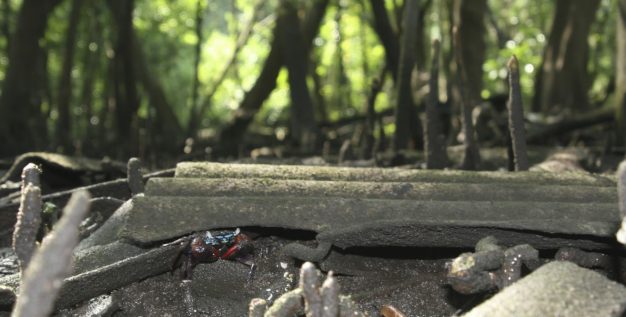
The crustacean star of this discovery is a common resident of Singapore’s Mandai mangroves. Both male and female face-banded crabs sport striking, coloured facial bands—males with blue, females with green. The crabs use these colours to communicate messages to attract mates, challenge rivals, or warn off predators. But it’s not just the colour that grabs attention. Their facial bands shine especially brightly amidst the muddy browns of their swampy home, almost as if the crabs are equipped with tiny headlights. What makes the facial bands so dazzling has remained a mystery—until now.
In a recently published study, the research team closely examined the facial bands using spectrophotometers, powerful microscopes, and computer modelling, and discovered that they have a unique curved structure—much like the reflector in a car’s headlamp. This means that the facial bands do not just passively reflect light; they focus it, bouncing incoming light back at just the right angle to make the bands appear brighter to other crabs close by. Think of it as nature’s way of turning up the brightness knob, ensuring their signals don’t get lost in the dim, tangled mangrove environment.
To test whether this brightness actually matters to the crabs, Prof Todd and his research team ran a series of choice experiments. They discovered that both male and female crabs preferred images of crabs with brighter facial bands, regardless of colour. But colour still played a role: crabs also tended to prefer images with facial bands of their own sex’s colour. This points to a complex communication system, where both brightness and colour are important parts of the crabs’ visual communication toolkit and could convey different pieces of information.
Why do these crabs have such “headlamp bands”? Dr Chan suggests that the crabs often hide in burrows to avoid being eaten but the dim lighting of mangrove swamps makes it difficult for the crabs to spot each other within their burrows. Hence, having a bright, focused signal helps them to communicate with one another more effectively. This type of innovation is surprisingly rare in the animal kingdom, making Parasesarma eumolpe’s headlamp-like bands an example of nature’s many fascinating wonders. Who knows—maybe the next time you’re walking through a mangrove forest, you might spot a crab flashing its headlamps at you!