
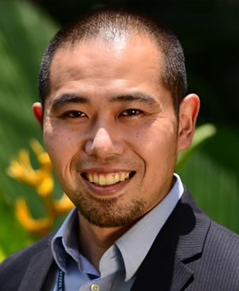
DAISUKE URANO
Adjunct Associate Professor
Contact Information:
TLL
1 Research Link, National Univ of Singapore,
117604
Institution Webpage: https://www.tll.org.sg/people/daisuke-urano/
LinkedIn: https://www.linkedin.com/in/daisuke-urano-73206a86/
6872-7423
daisuke@tll.org.sg
Research Areas
-
Mechanisms of Plant-Environment Interactions
-
Evolution-to-Innovation at System and Protein Levels
-
Precision Agriculture and Plant Sensing Technologies
Research Interests
Evolution-to-Innovation at System and Protein Levels:
A deep understanding of evolutionary mechanisms, from genes and proteins to complex regulatory networks, has the potential to transform the design and refinement of new biological systems (e.g. introduction of desirable traits into crops). By integrating transcriptomic, metabolomic, and phenotypic data, we have explored evolution and diversity at the system level, while protein sequences and in silico structural prediction and molecular dynamics have revealed longer-term evolutionary processes at the scale of individual proteins. This approach has allowed us to uncover the evolution and diversification of G protein properties (e.g., intrinsic enzymatic activity, binding partner specifications), adapting to their nanoscale environment within cells. At the systems level, our work has advanced the understanding of gene regulatory network evolution, highlighting uneven mutation rates in cis– and trans-regulatory elements and the role of exaptation in network evolution.
Precision Agriculture and Plant Sensing Technology:
Plant sensing technologies have the potential to transform agricultural production and food safety. For example, high-throughput phenotyping systems enable large-scale, data-driven decision-making in farm management, while highly sensitive and selective chemical sensors allow trace-level detection of specific chemicals and pollutants in food and the environment. Through collaborations, we have developed several plant sensing platforms utilizing single-walled carbon nanotubes and a range of optics-based approaches. In parallel, we investigate the interactions between plant tissues and biomaterials to identify biocompatible materials for precision agriculture. Knowledge from this biomaterial interface research guides the context-specific design and development of advanced nanotechnology tools, such as microneedles for precise agrochemical delivery and in situ plant monitoring.
Selected Publications
Plant and Algal Responses to Environmental Stresses:
-
Dong Y; Krishnamoorthi S; Tan GZH; Poh ZY; Urano D* (2024) Co-option of plant gene regulatory network in nutrient responses during terrestrialization. Nature Plants 10: 1955-1968.
-
Krishnamoorthi S; Tan GZH; Dong Y; Leong R; Wu T; Urano D* (2024) Hyperspectral imaging of liverwort Marchantia polymorpha identifies MpWRKY10 as a key regulator defining Foliar pigmentation patterns. Cell Reports 43: 114463
-
Leong R*, Tan J, Koh S, Wu TY, Ishizaki K, Urano D* (2023) G protein-signaling and metabolic pathways as evolutionarily conserved mechanisms to combat calcium deficiency. New Phytologist 237: 615-630.
-
Wu TY*, Krishnamoorthi S, Boonyaves K, Al-Darabsah I, Leong R, Jones AM, Ishizaki K, Liao KL*, Urano D* (2022) G protein controls stress readiness by modulating transcriptional and metabolic homeostasis in Arabidopsis thaliana and Marchantia polymorpha. Molecular Plant 15: 1889-1907.
-
Wu TY*, Hoh KL, Boonyaves K, Krishnamoorthi S, Urano D (2022) Diversification of Heat Shock Transcription Factors expanding thermal stress responses during early plant evolution. Plant Cell 34: 3557–3576.
-
Boonyaves K*, Wu TY, Dong Y, Urano D* (2022) Interplay between ARABIDOPSIS G-beta and WRKY transcription factors differentiates environmental stress responses. Plant Physiology 190: 813-827.
-
Wu TY*, Goh H, Azodi CB, Krishnamoorthi S, Liu MJ, Urano D* (2021) Evolutionarily conserved hierarchical gene regulatory networks for plant salt stress response. Nature Plants 7: 787-799.
Precision Agriculture and Plant Sensing Technology:
-
Krishnamoorthi S, Koh SS, Ang MCY, Teo MJT, Ang RJ, Dinish US, Strano M*, Urano D* (2025) Advancements in plant diagnostic and sensing technologies. Advanced Sensor Research e00045 (review article)
-
Krishnamoorthi S, Urano D* (2025) Hyperspectral reflectance imaging and spectral component analysis techniques to reveal distinct color patterns on plant leaves. STAR Protocols 6: 103854
-
Cao Y, Kim D, Koh SS, Li Z, Rigoldi R, Fortmueller JE, Goh K, Zhang Y, Lim EJ, Sun H, Uyehara E, Cheerlavancha R, Han Y, Ram RJ, Urano D, Marelli B* (2025) Nanofabrication of silk microneedles for high-throughput micronutrient delivery and continuous sap monitoring in plants. Nature Nanotechnology 20: 1142–1151
-
Khong DT, Tan GZH, Cheerlavancha R, Tan JJ, Ahsim R, Jayapal PK, Ang MCY, Wang S, Loh SI, Singh GP, Marelli B, Urano D*, Strano MS* (2025) Nanosensor for Fe(II) and Fe(III) allowing spatiotemporal sensing in planta Nano Letters 25: 2316-2324
-
Cao Y, Koh SS, Han Y, Tan JJ, Kim D, Chua NH, Urano D*, Marelli B* (2023) Drug Delivery in Plants Using Silk Microneedles. Advanced Materials 35: 2205794. doi:10.1002/adma.202205794.
-
Dinish US*, Teo MJT, Teo VX, Dev K, Tan JJ, Koh SS, Urano D*, Olivo M* (2023) Miniaturized Vis-NIR handheld spectrometer for non-invasive plant pigment quantification Scientific Reports 13: 9524
-
Koh SS, Dev K, Tan JJ, Teo VX, Zhang S, Dinish US*, Olivo M*, Urano D* (2023) Classification of plant endogenous states using machine learning-derived agricultural indices. Plant Phenomics
-
Boonyaves K, Ang MCY, Park M, Cui J, Khong TD, Singh GP, Koman V, Gong X, Porter T, Choi SW, Chung K, Chua NH, Urano D*, Strano M*. (2023) Near-infrared Fluorescent Carbon Nanotube Sensors for Plant Hormone Family Gibberellins. Nano Letters 23: 916-924.
-
Zhang R, Koh SS, Teo MJ, Bi R, Zhang S, Dev K, Urano D*, Dinish US*, Olivo M*. (2022) Handheld multifunctional fluorescence imager for non-invasive plant phenotyping. Frontiers in Plant Science 13: 822643
Some of my postdoctoral work was published in Nature Cell Biology (2012), PLoS Genetics (2012), Science Signaling (2013, 2016), Plant Physiology (2013, 2015), Annual Review of Plant Biology (2014), Journal of Experimental Botany (2014, 2015), and Molecular Biology and Evolution (2015). These studies investigated how protein sequence diversity drives structural and functional variation in eukaryotes, laying the foundation for our core research program “Evolution-to-Innovation at System and Protein Levels”. The full publication list can be found at http://www.tll.org.sg/group-leaders/urano-daisuke/.