
NEWS – George Mercer Award
Assoc. Prof. Ryan Chisholm receives the George Mercer Award from the Ecological Society of America
The Ecological Society of America has awarded the prestigious 2025 George Mercer Award to Lynette H. L. Loke and Ryan A. Chisholm, authors of “Unveiling the Transition from Niche to Dispersal Assembly in Ecology,” published in Nature on 7th June 2023. The George Mercer Award was established in 1948 and is given annually for an outstanding ecological research paper published in the last two years whose lead author is under 40. Ryan Chisholm is an Associate Professor and heads a theoretical ecology and modelling lab in the Department of Biological Sciences. Lynette Loke is a former graduate of the department who currently heads a spatial and community ecology lab at the University of Melbourne.
The paper recognised by the award tested rival theories about ecological community assembly using experiments conducted on intertidal communities in Sentosa, Singapore. Classic theory suggested that niches would set a ceiling on the number of species coexisting in a community, and that only low immigration of new species would keep communities from reaching this ceiling. An alternative theory proposed in previous work from Chisholm’s lab suggested the opposite: that niches would set a floor on the number of coexisting species, and that immigration would typically maintain the number of species above this floor. The field experiment used a novel community assembly design to manipulate immigration rates, and then the authors applied mathematical models to the data to test alternative hypotheses for community assembly. The results supported the novel theory, indicating that niches provide a low floor on species diversity and suggesting that in nature, where immigration is typically high, most species coexist only transiently.
The awards committee wrote in their announcement, “Deftly integrating field experiments with clear hypotheses and mathematical modeling, this study provides novel insights into an ecological question that has been debated for decades. The results of the paper advance our understanding of the forces structuring ecological communities, and the authors combine theory and empirical evidence in a creative and exceptionally well-written way.”

Each experimental unit in Loke & Chisholm (2023) comprised a custom-built habitat tile with a stainless steel cage and polycarbonate panels containing several holes, the number of which was adjusted across units to modulate immigration. Photo credit: Lynette Loke

A selection of the intertidal animals observed in the experiment. Photo credit: Lynette Loke
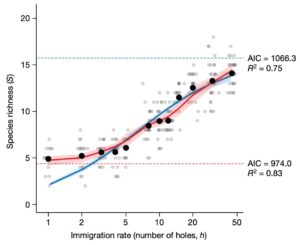
The relationship between species richness and immigration rate in the experiment exhibited a low floor at low immigration rates, consistent with the novel theory (red), rather than a high ceiling at high immigration rates, as predicted by the classic theory (blue).