

SANJAY SWARUP
Associate Professor
Contact Information:
Department of Biological Sciences
National University of Singapore
14 Science Drive 4
Singapore 117543
Additional Affiliations:
Director, NUS Environmental Research Institute (NERI) www.nus.edu.sg/neri
Director, Graduate Program & Deputy Director, Environmental Engineering Cluster | Singapore Centre for Environmental Life Sciences Engineering (SCELSE) | Nanyang Technological University | SBS-01n-15, 60 Nanyang Drive, Singapore 637551 | Tel: (65) 6316 2820 GMT+8h | Fax: (65) 6791 3856
6516 7933
6779 2486
dbsss@nus.edu.sg
Academic Qualifications
PhD UF (USA), PhD, Msc IARI, BSc PAU India
Agri-Environmental Systems Biology Group
Our group is interested to determine mechanistic basis of ecosystem functioning from molecular to organismal and landscape scales. We are interested to understand complex relationships in agro-ecosystems and environmental systems in order to provide transnational tools and explanations for policy and management decisions. We are taking a multidisciplinary approach by incorporating hydrology, robotics and AI, meta-genomics, metabolomics, computational, and high-resolution imaging to study these interesting biological systems.
Our group studies how microbial communities or “microbiomes” and their life on interfaces of solid, liquid or air as “biofilms” drive the processes occurring in natural environments such as surface freshwater or plant surfaces. Members of these species share resources such as metabolites or metabolic signals and they have diverse interactions with their hosts and immediate environments, all based on ecological principles.
We are taking a multidisciplinary approach by incorporating hydrology, meta-genomics, metabolomics, computational, and high-resolution imaging to study these interesting biological systems.
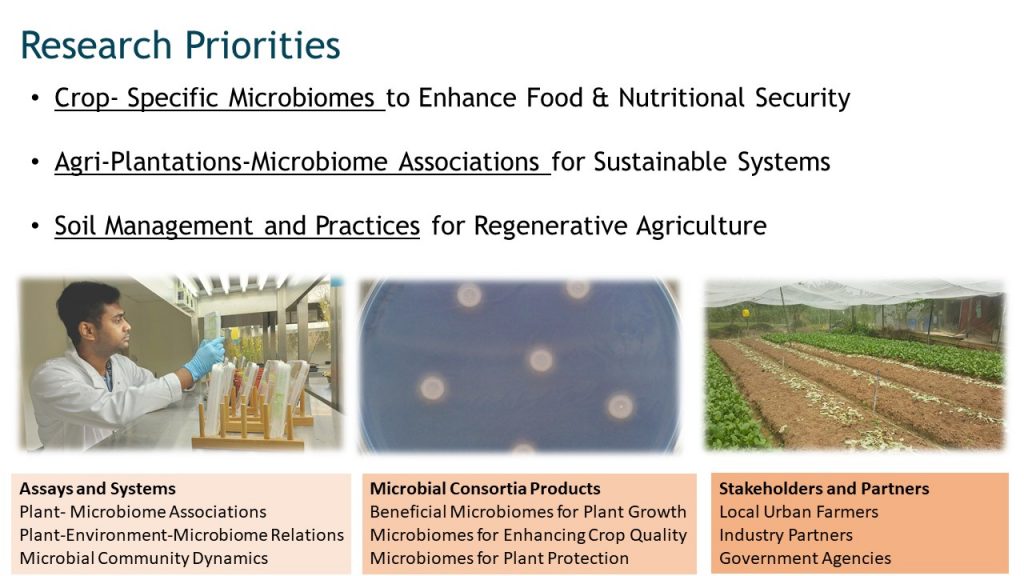
More details on on-going research themes are available on our website.
About the PI of the group – Sanjay Swarup
I am an agriculture and environmental biologist. Programs in my laboratory are shaped by my training in field-based themes of plant breeding and plant pathology combined with lab-based training in molecular biology. Through these programs, we have built the capability to understand complex environmental systems and provide meaningful solutions that can be translated.
I have co-authored more than 90 peer-reviewed publications in journals of international repute. I have been invited to share our research findings at leading international conferences. My h-index is 25 and our work has received attention from local/regional and international scientific community. I serve on several editorial boards and professional societies. I contribute actively towards pushing the frontiers in the field and organize focus group workshops, sharing sessions and other events for young researchers. I am a consultant for several multi-national companies working in agri-tech space.
I am the principal investigator for a multi-disciplinary project on improving crop production for green leafy vegetables supported by Competitive Research Programme under National Research Foundation. Apart from this, I have received support from other funding agencies for evaluating microbiome potential for alternate protein sources as well developing smart farming solutions for nutritious, high-quality crops
Selected Publications
- Chandran S, Loganathachetti DS, Sadaiappan B, Swarup S, Mundra S. Irrigation water and soil chemistry shape fungal guilds in date palm soils, enhancing pathotroph abundance under saline groundwater irrigation. Current Research in Microbial Sciences. 2025;8:100370.
- Ismail MS, Sulistijorini S, Muttaqin M, Al Anshori Z, Rizaldi MR, Wijedasa L, et al. Elemental Stoichiometry of Tropical Peatland Trees: Implications for Adaptation and Carbon Sequestration. Forests [Internet]. 2025; 16(9):[1379 p.].
- Low JM, Gupta A, Toh R, Lim SL, Chan S-Y, Swarup S, et al. Vertical Transmission of Gut Dysbiosis From Mothers With Gestational Diabetes to Infants. Journal of Diabetes. 2025;17(10):e70148.
- Mukherjee A, Han L, Mukhopadhyay S, Kopriva S, Swarup S. Sulfur traits in the plant microbiome: implications for sustainable agriculture. Trends in Microbiology. 2025;33(6):635-49.
- Mukherjee A, Mazumder M, Verma A, Tikariha H, Bhattacharya R, Ooi QE, et al. A bacterial signal coordinates plant-microbe fitness trade-off to enhance sulfur deficiency tolerance in plants. Cell Host & Microbe. 2025;33(10):1748-64.e6.
- Mukherjee A, Tan BH, Swarup S. In Silico Prediction and In Vitro Validation of Bacterial Interactions in the Plant Rhizosphere Using a Synthetic Bacterial Community. Bio-protocol. 2025;15(21):e5496.
- Roy K, Sim D, Wang L, Zhang Z, Guo X, Zhu Y, et al. A Generative AI-Assisted Piezo-MEMS Ultrasound Device for Plant Dehydration Monitoring. Advanced Science. 2025;12(32):e04954.
- Swarup S, Gupta A, Chung M, Radhakrishnan V, Davis V, Lynch MDJ, et al. Rapid shift of gut microbiome and enrichment of beneficial microbes during arhatic yoga meditation retreat in a single-arm pilot study. BMC Complementary Medicine and Therapies. 2025;25(1):51.
- Taillardat P, Moore J, Sasmito S, Evans CD, Alfina T, Lok S, et al. Methane and Carbon Dioxide Production and Emission Pathways in the Belowground and Draining Water Bodies of a Tropical Peatland Plantation Forest. Geophysical Research Letters. 2025;52(4):e2024GL112903.
- Le Z, Mayalagu S, Chen C-Y, Bhattacharya R, Gupta A, Li J, et al. Microneedle-Based Biofertilizer Delivery Improves Plant Growth Through Microbiome Engineering. Advanced Functional Materials. 2026;36(13):e22554.
- Mazumder M, Pavagadhi S, Bhattacharya R, Mukherjee A, Majedi SM, Hin ITC, et al. Live-exudation assisted phytobiome culturomics system (LEAP-CS): a high-throughput culturomics system for studying plant-microbiome interactions through diffusible metabolites. Plant Methods. 2026.
- Mazumder M, Tikariha H, Mayalagu S, Majedi SM, Binti Abdul Hamid NA, Mukhopadhyay S, et al. An Ecology-Driven Microbial Consortium Enhances Plant Growth and Immunity While Sustaining Rhizospheric Microbial Balance. Plant Communications. 2026.
- Mukhopadhyay S, Ooi QE, Mukherjee A, Bhattacharya R, Sarkar P, Tan ZD, et al. Xenobiotic dynamics in mangroves and peatlands: Microbial mechanisms for nature-based mitigation. Journal of Hazardous Materials. 2026;511:142149.
- Ray SS, Goyal N, Gupta A, Swarup S, Mahapatra DM. Revealing Pesticide-Adapted Soil Microbiome through Shotgun Metagenomics. Bioresource Technology Reports. 2026;34:102737.