
AI and ML
We use deep learning to get more out of fluorescence correlation spectroscopy: precise answers from far less data, fast enough for real-time measurements.
Deep learning for real-time Imaging FCS
Imaging FCS maps how molecules move, how concentrated they are and how they interact across a whole image. The catch is data: a typical measurement needs about 100 MB, and evaluating it takes a lot of computation.
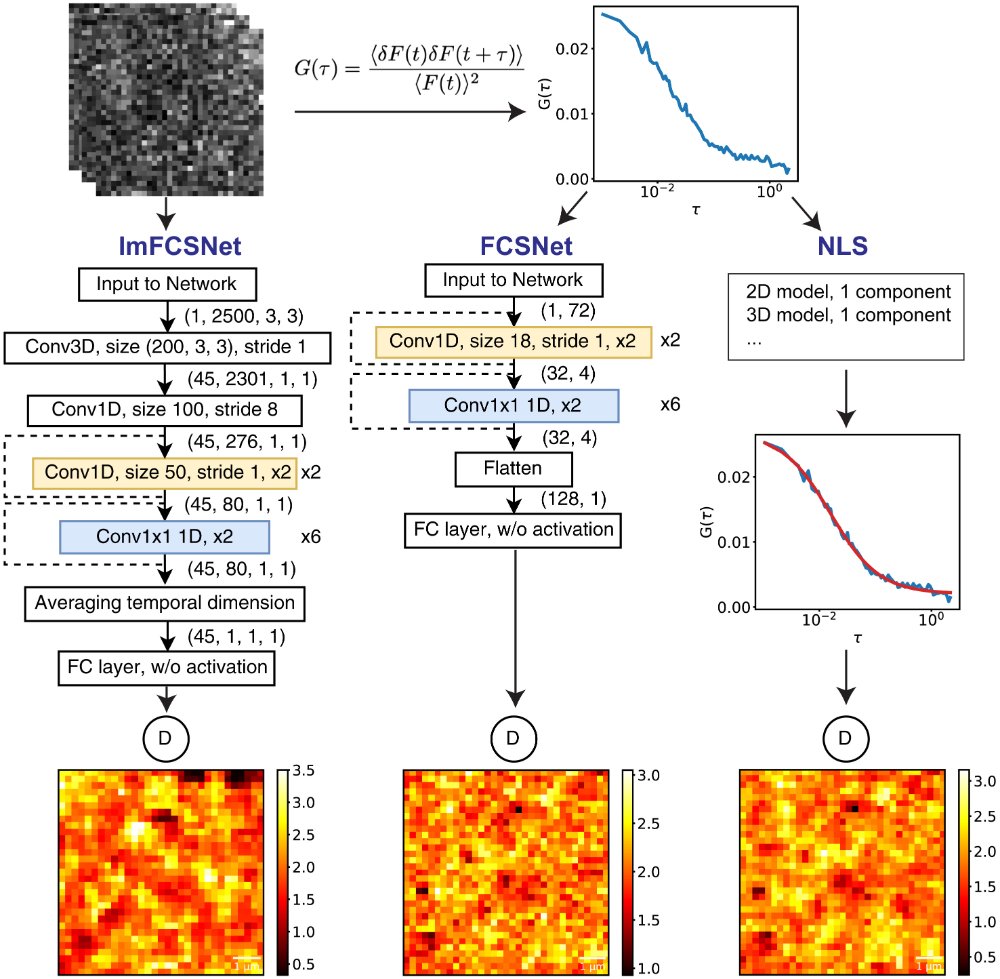
We developed two convolutional neural networks to cut that cost. FCSNet predicts the diffusion coefficient from the autocorrelation function of each pixel, while ImFCSNet works directly on the recorded image stack, trading off data requirements against spatial resolution. Both were trained on simulated data, so they are model agnostic and can be used with any microscope setup.
Tested on artificial membranes, live cells and small organisms, both networks measured diffusion coefficients more precisely than conventional FCS fitting while needing only about 5 MB per measurement, which opens the way to evaluation orders of magnitude faster and real-time measurements.
In collaboration with Prof. Adrian Röllin, Department of Statistics and Data Science, NUS.
Recent publications
- Deep learning reduces data requirements and allows real-time measurements in Imaging FCSTang WH, Sim SR, Aik DYK, Nelanuthala AVS, Athilingam T, Röllin A, Wohland TBiophysical Journal (2024). doi.org/10.1016/j.bpj.2023.11.3403Deep learning for Imaging FCS