
Bilayers
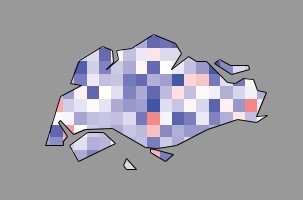
We use imaging FCS on supported lipid bilayers and live cell membranes to understand how lipids organise into domains, and how proteins and small molecules change that organisation.

Phase separation in live cell membranes
The plasma membrane is a mixture of many lipids and proteins, and whether it forms ordered domains, often called rafts, is still debated. Imaging FCS reports three complementary parameters for each probe: how fast it diffuses, how tightly it is packed (activation energy) and whether it diffuses freely, in domains or by hopping between compartments (FCS diffusion law).
By inducing phase separation in live cell membranes with heptanol, we determined which phase different membrane molecules prefer, and showed that membrane organisation depends strongly on the probe, the cell line and temperature.
How a plant protein protects membranes
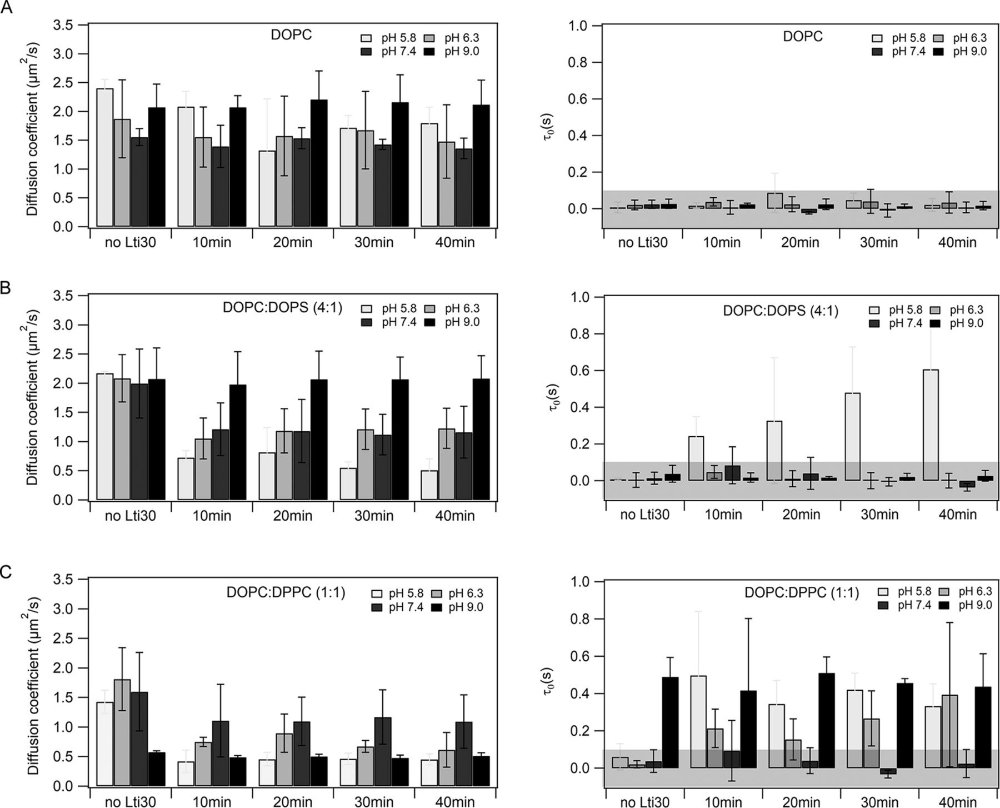
Using imaging total internal reflection FCS and molecular dynamics simulations on supported lipid bilayers, we showed how the plant dehydrin Lti30 protects membranes during cold and drought stress: it binds lipids electrostatically in a pH-dependent way, cross-linking them and restricting their mobility.
Recent publications
- Heptanol-mediated phase separation determines phase preference of molecules in live cell membranesGupta A, Lu D, Balasubramanian H, Chi Z, Wohland TJournal of Lipid Research (2022). doi.org/10.1016/j.jlr.2022.100220Phase separation
- The disordered plant dehydrin Lti30 protects the membrane during water-related stress by cross-linking lipidsGupta A, Marzinek JK, Jefferies D, Bond PJ, Harryson P, Wohland TJournal of Biological Chemistry (2019). doi.org/10.1074/jbc.RA118.007163Dehydrin Lti30