
Viruses
Dengue infects around 400 million people every year and has no effective treatment. We combine fluorescence spectroscopy, single-molecule methods and molecular dynamics simulations to understand how the virus changes its structure as it moves between mosquito and human hosts.
Dengue virus envelope dynamics
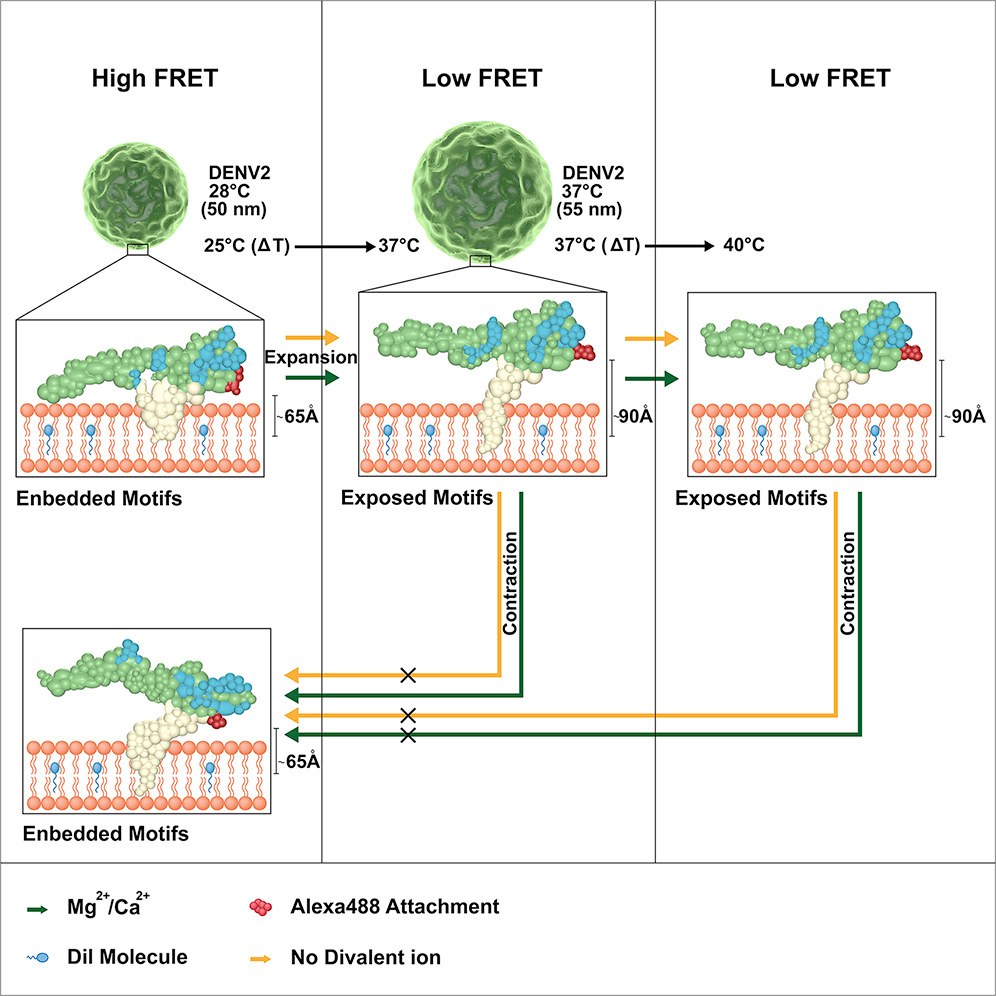
Flaviviruses such as dengue are not rigid particles. Their envelope proteins rearrange with temperature, pH and host interactions, a behaviour known as viral “breathing” that is essential to the virus life cycle.
We observe hitherto unseen conformational changes and structural dynamics of the DENV2 envelope that are influenced by both temperature and divalent cations. Our results show that for DENV2 and DENV1 the intrinsic dynamics, but not the specific morphologies, are correlated with viral infectivity: the virus structure changes between mosquito and human temperatures, but infectivity and dynamics change only at fever-like temperatures of 40 °C.
Read more on the full dengue page.
The capsid protein as an RNA chaperone
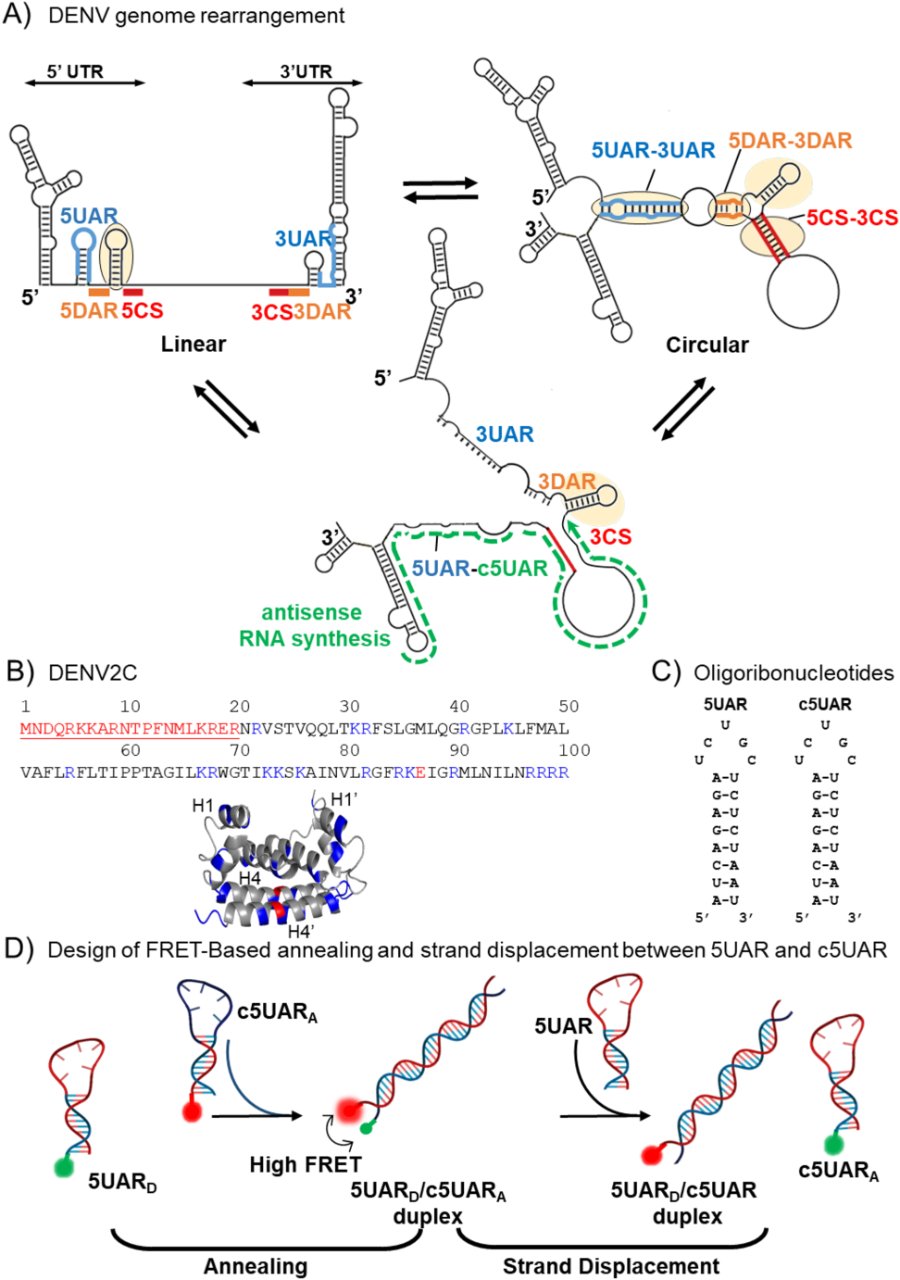
To replicate, the dengue genome must switch between linear and circular forms, which requires RNA strands to anneal and to be displaced. The viral capsid protein acts as an RNA chaperone for both steps.
Using single-molecule FRET and molecular dynamics simulations, we showed that flexibility in the ordered domain of the capsid protein is essential: a mutation that makes this region rigid leaves the protein able to anneal RNA strands but no longer able to displace them.
Recent publications
- Structural flexibility in the ordered domain of the dengue virus strain 2 capsid protein is critical for chaperoning viral RNA replicationSharma KK, Raghuwamsi PV, Aik DYK, Marzinek JK, Bond PJ, Wohland TCellular and Molecular Life Sciences (2025). doi.org/10.1007/s00018-025-05712-xCapsid protein