
Zebrafish
Light-sheet (SPIM) based FCS takes quantitative, single-molecule-sensitive measurements into living zebrafish embryos, so we can follow how signalling molecules move through a developing organism.
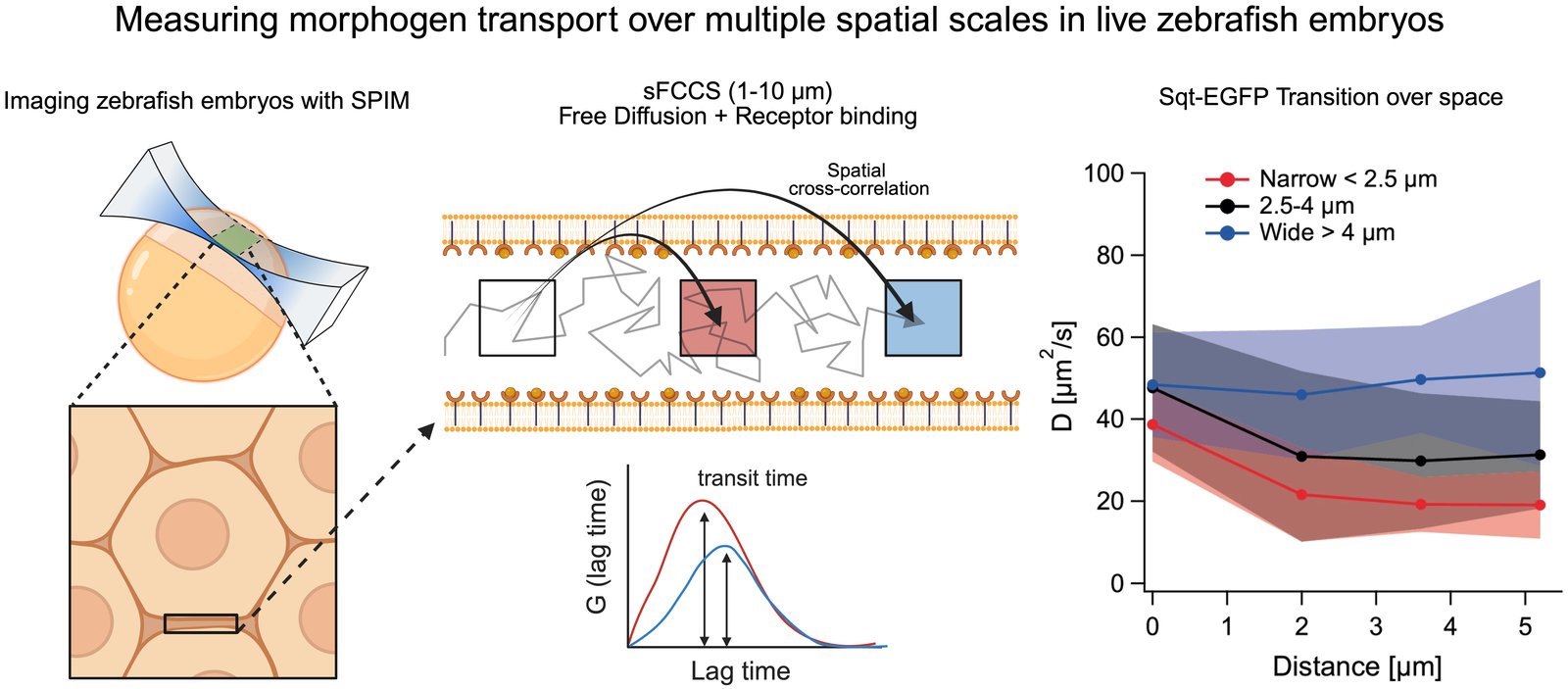
Morphogen transport over multiple spatial scales
Morphogens are signalling molecules that spread through tissue to pattern the embryo, but how they travel through the narrow, crowded spaces between cells has been hard to measure directly.
Using SPIM-based spatial fluorescence cross-correlation spectroscopy (sFCCS) over 1 to 10 µm, we followed the morphogen Squint (Sqt-EGFP) through the extracellular space of live zebrafish embryos, separating free diffusion from receptor binding. In narrow gaps between cells, transport slows with distance, while in wider spaces it stays fast.
For our earlier work in tissues and organisms, see measurements in tissues and organisms.
Recent publications
- Measuring morphogen transport over multiple spatial scales in live zebrafish embryosNelanuthala AVS, Saha B, Sankaran J, Teh C, Carney TJ, Sampath K, Wohland TNature Communications (2026). doi.org/10.1038/s41467-026-73639-3Morphogen transport